The mistakes you're probably making
| Mistake | What it does to the shot | The fix |
|---|---|---|
| Gripping too tightly | Locks the wrists and forearms; slow, weak, often pushed right | Loosen until the club feels secure but the wrists move freely |
| Swinging too hard | Lost balance, poor contact, big misses in both directions | Swing at a pace you can hold your finish from |
| Trying to lift the ball | Thin shots that run along the ground and fat shots that go nowhere | Strike down; the loft does the lifting |
| Poor alignment | Good swings that end up in the wrong place | Clubface first, then body, using an intermediate target |
| Swaying instead of turning | Inconsistent contact because the low point of the swing moves | Turn around a stable spine; feel the trail hip rotate, not slide |
| Looking up early | Topped shots and pulls | Watch the ball until it's gone, then let the head turn through |
| Wrong club for the shot | Short of the green, in the bunker, in the water | Take enough club for your average strike, not your best |
Three faults that hide behind the others
Almost every item in that table traces back to one of three causes. The first is tension. A tight grip tenses the arms, tense arms shorten the swing, a short swing gets rushed. The second is the instinct to help the ball into the air. Golf is one of the few sports where you hit down to make the ball go up, and the instinct fights you for months. The third is impatience: hitting the next ball before you've understood the last one. Address those and most of the table takes care of itself.
Drills that build consistency
- Feet-together swings. Hit half shots with a wedge with your feet touching. You cannot sway, and you cannot swing hard without falling over. It teaches balance and centred contact faster than any tip.
- Alignment sticks. Lay one along your toe line and one just outside the ball pointing at the target. Set up to them every shot on the range. Your eyes learn what square looks like.
- The towel under the arms. Tuck a towel across your chest under both armpits and hit soft shots without dropping it. Arms and body learn to move together.
- Count your tempo. Say "one" on the takeaway and "two" at impact. When the count gets ragged, you've sped up. Slow the count down and let the swing follow.
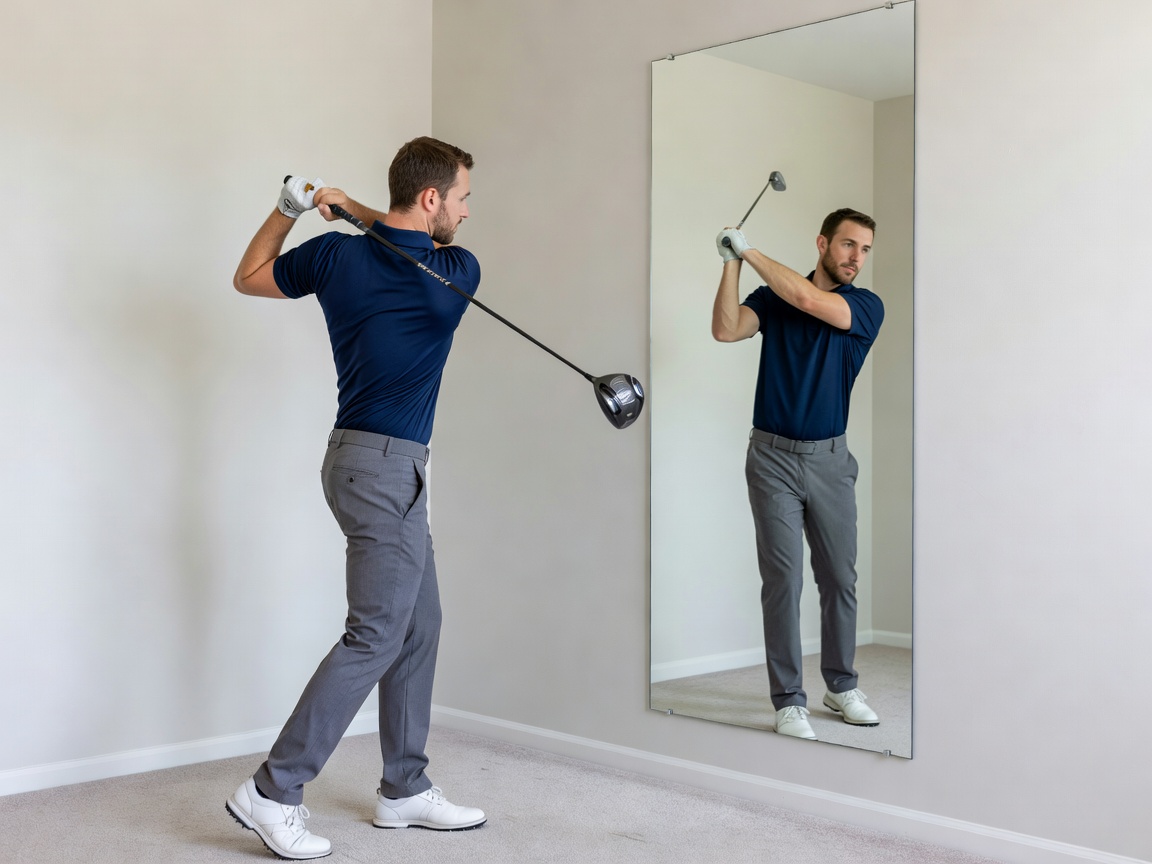
- Slow-motion swings. Make full swings at a fraction of normal speed, stopping at the top and at impact to check your position. Do this at home without a ball.
- Divot check. On grass, put a tee in the ground beside the ball. After the shot, look where the divot starts. In front of the tee is right. Behind it means you're hitting the ground first.
Physical exercises for the swing
These are general suggestions for healthy adults. If you have a back, shoulder, hip or knee condition, or any doubt about your fitness, speak to a doctor or physiotherapist before starting. A golf-specific coach or trainer can tailor a routine to you.
Hip and upper-back mobility. The swing is a rotation, and most desk-bound adults can't rotate very far. Gentle seated trunk rotations, hip openers and thoracic stretches done regularly give you a fuller turn without forcing it. A bigger turn means more room to generate speed smoothly, so you stop trying to hit hard with your arms.
Balance. Standing on one leg while you swing a club slowly, or simply while you brush your teeth, trains the stability that lets you finish in control. Balance work is unglamorous. It's also the single biggest difference between the swing you make on the range and the one you make when a shot matters.
Core stability. Planks, side planks and bird-dog holds teach the midsection to stay firm while the limbs move. In the swing, that's what keeps the low point steady while everything else turns around it.
Glutes and legs. Bodyweight squats, lunges and bridges build the base the swing starts from. The downswing begins with the lower body; if the lower body is weak, the arms take over and the sequence breaks.
Keep it modest. A few minutes most days beats an hour once a fortnight, and it's the regularity that transfers to the course. Warm up before you play as well: some arm swings, trunk turns and a few slow practice swings, building gradually to full speed. Cold muscles and a driver on the first tee is how beginners get hurt.
How to practise so it sticks
One thing per session. Write it down before you start. Stop when you've done it.
Block practice, where you hit the same shot again and again, is good for learning a movement. Random practice, where you change club and target every shot, is good for taking that movement to the course. Use block practice early in a session and random practice at the end. And every so often, play a round where you don't keep score at all. Pay attention to what you're actually doing over the ball. That's where the next improvement is hiding.