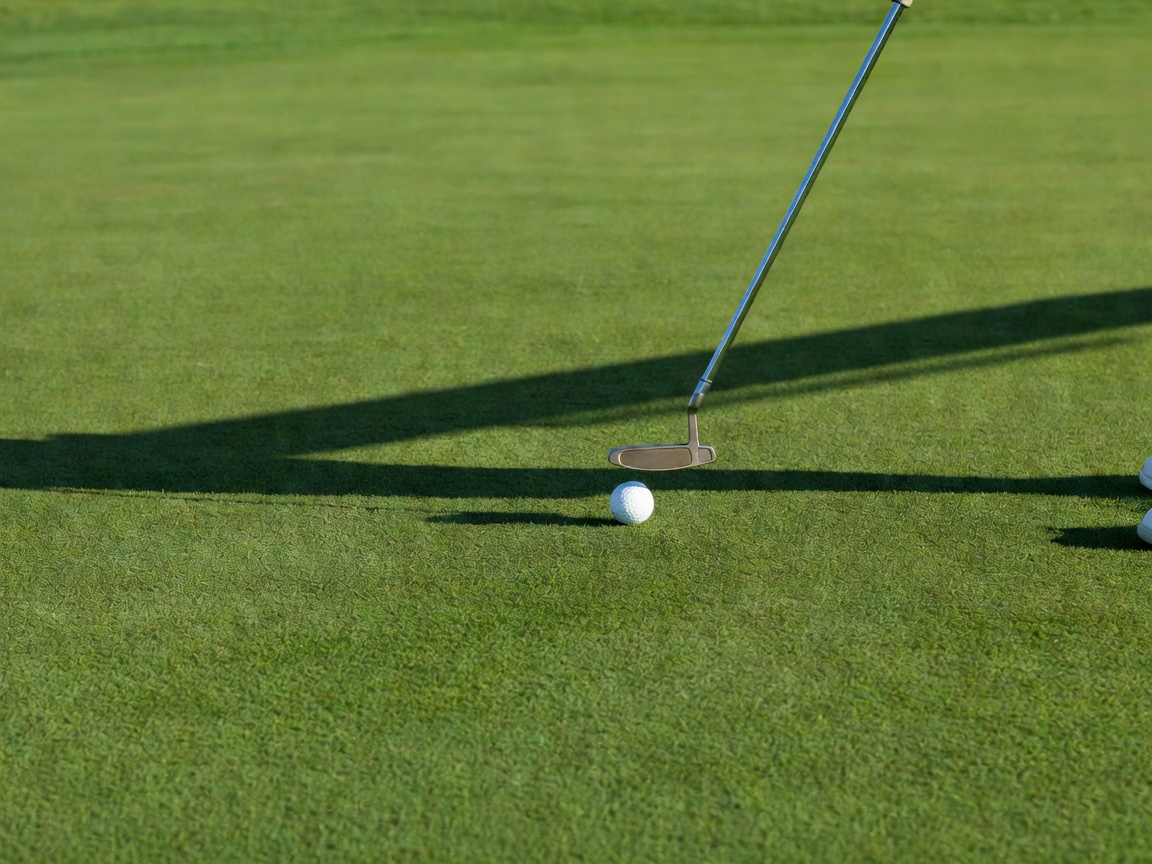
Why putting first
A missed drive costs you one shot. A three-putt costs you one shot too, and it happens far more often. Beginners tend to spend their practice time on the range and their round on the green wishing they hadn't. Flip that. Putting asks nothing of your fitness, your flexibility or your equipment. It asks for a steady stroke, a decent read and a plan. All three can be learned.
Set up over the ball
Stand so your eyes are over the ball, or just inside the line. Drop a ball from the bridge of your nose at address; where it lands tells you where your eyes are. Your feet, hips and shoulders sit parallel to the line you want the ball to start on. Your arms hang without tension and your hands sit roughly under your shoulders. Weight is even, or slightly favouring your lead side, and it stays there.
The putter grip is different from the full-swing grip. The club sits more in the palms and the lifeline of each hand, which quietens the wrists. Most players use one of these.
| Grip | What it does | Watch for |
|---|---|---|
| Reverse overlap | Top hand's index finger rests over the fingers of the bottom hand; the most common starting point | Bottom hand taking over on short putts |
| Cross-handed (lead hand low) | Swaps the hands, so the lead hand sits below; levels the shoulders and steadies the wrists | Feels odd at first; distance control takes time to return |
| Claw | Bottom hand holds the grip between thumb and fingers like a pencil, taking it almost out of the stroke | Less feel on long putts |
The stroke: a pendulum, not a hit
Your shoulders drive the stroke. Your arms and the putter move as one unit, swinging back and through like a pendulum hung from your neck. Your wrists stay quiet. Your head and lower body stay still. The putter head travels low to the ground, back and through, roughly the same distance either side of the ball.
Accelerate through the ball. The most common fault is a long backstroke followed by a stab that decelerates into impact; the ball comes off dead and short, or hops offline. Think of the follow-through as slightly longer than the backstroke and the problem tends to fix itself. Listen for a solid click. A thin, clicky sound means you caught it low on the face.
Reading the green
Start reading as you walk up to the green. The big slopes are easier to see from a distance than from over the ball. Then look from behind the ball, low, so the surface is at eye level. Walk to the low side of the putt, where the break is most visible. Look from behind the hole if you have time and it won't slow your group.
Ask two questions. Is it uphill or downhill? Where would water run if you poured it on the line? The ball behaves like the water. Then pick a spot on the high side of the hole to aim at and commit to it. Doubt over the ball is worse than a slightly wrong read.
Distance control beats direction
Most three-putts come from a first putt that was the wrong length, not the wrong line.
Control distance with the length of your stroke, not the force. A longer stroke for a longer putt, at the same rhythm. On long putts, your goal is simple: leave the ball within a comfortable tap-in of the hole. On short putts, be firm enough to hold the line. There's a long-running argument between rolling the ball to die at the hole and hitting it firmly at the back of the cup. The dying putt takes more of the hole; the firm putt takes less break. Beginners usually score better erring toward firm on short putts and soft on long ones.
Build a routine and keep it short
- Read the putt from behind the ball and pick your line.
- Take one or two practice strokes beside the ball, looking at the hole, feeling the distance.
- Set the putter face behind the ball, square to your line. Then set your feet.
- One look at the hole. Eyes back to the ball. Go.
The routine is there to stop you thinking. Do the same thing every time and the stroke becomes automatic, which is exactly what you want when the putt matters.
Practice that actually helps
Push two tees into the practice green slightly wider than your putter head and stroke putts through the gate. It shows you instantly if the putter is swinging off line. Set balls at increasing distances in a line and work your way out, trying to leave each one just past the hole. Putt one-handed with your lead hand only to feel the pendulum. Ten minutes on the practice green before a round is worth more than ten minutes on the range, and it costs nothing.
Choosing a putter
Blade putters are slim, traditional and give more feedback through the hands. Mallets are larger, more forgiving of off-centre strikes and often easier to aim thanks to their alignment lines. Neither is better; the one you aim well with is the right one. What matters most is length. A putter that is too long pushes your eyes inside the line and your hands away from your body. Have the length checked by a club fitter or a coach before you spend money on a head shape.